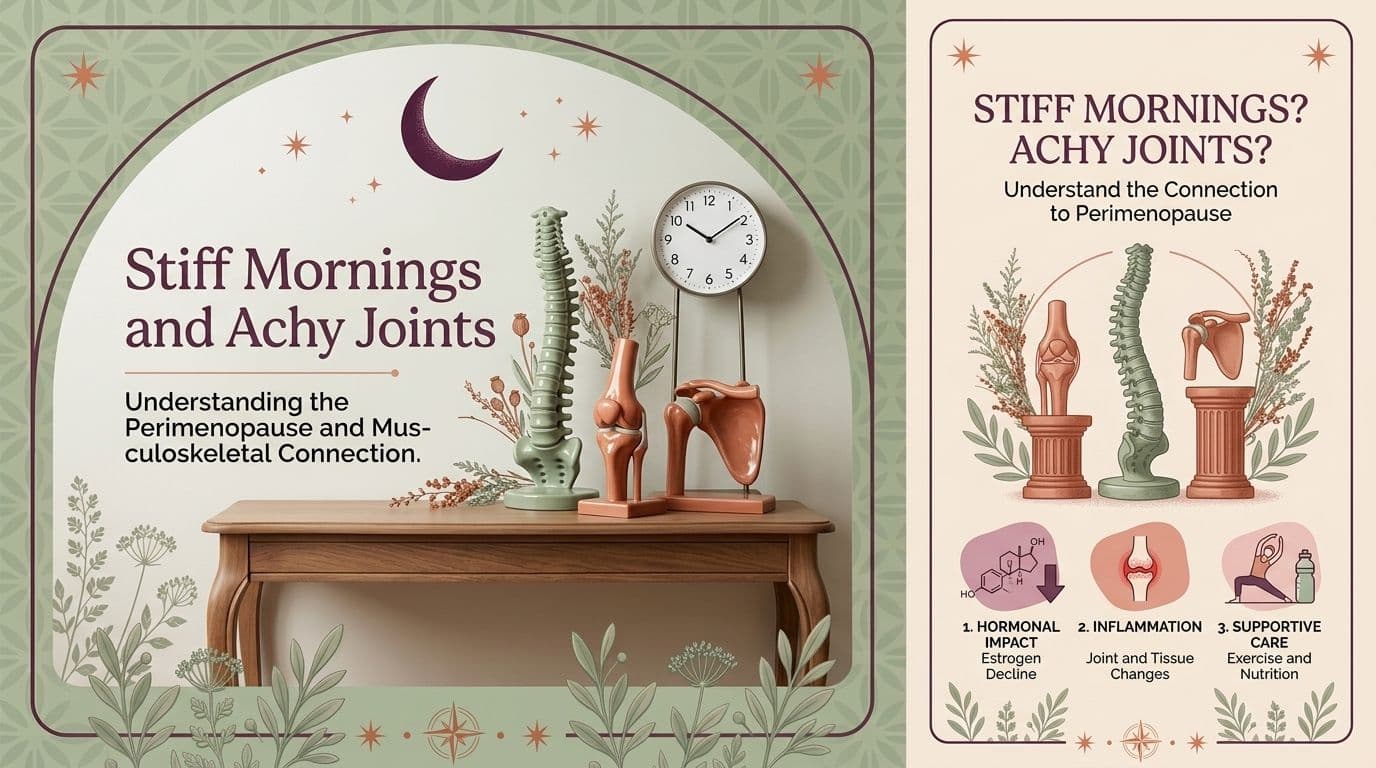
Legs swing over the bed and your hands feel like they belong to someone eighty years older than you. Shoulders ache. Knees complain on the first stairs of the day. By the time the coffee's made, you've loosened up a bit, but there's a new question at the kitchen table with you: when did I get creaky?
If your joints started clocking on somewhere in your forties, right alongside your period going feral or your sleep falling apart, they're probably connected. This one gets written off constantly as "just getting older" or "too much gardening," and it deserves better than that.
You're in good company
A 2020 review found 71 per cent of perimenopausal people get musculoskeletal pain: joints, muscles, ligaments, tendons. And perimenopausal women have a higher risk of moderate to severe pain than premenopausal women, which suggests it's not just the slow march of birthdays. Jean Hailes lists hands, knees, hips, shoulders and lower back as the usual suspects, worst on waking.
Why now: the oestrogen connection
Oestrogen protects bones and joints and keeps tendons, ligaments and cartilage healthy. When it fluctuates and falls, that protection thins out. But here's the honest bit: researchers haven't proven a direct causal link for most joint problems yet. Much of the connection is likely indirect, via poor sleep (heightens pain perception), fatigue (makes movement feel harder, so you move less, so joints stiffen), and low mood (well-established loop with pain). The pain's real either way. There are just more levers than you might've thought.
Frozen shoulder, the one everyone asks about
Adhesive capsulitis: the tissue around the shoulder joint gets thick, tight and inflamed. Three stages: freezing (pain builds, movement drops, six weeks to nine months), frozen (pain eases but the shoulder's genuinely stuck, four to six months), thawing (movement slowly returns, six months to two years). A long road, which is why catching it early matters.
There's no proven direct link between menopause and frozen shoulder, researchers suspect an indirect route via sleep, fatigue and mood. One small 2023 study found people not on MHT had a 99 per cent greater chance of frozen shoulder than those on it, which sounds enormous and made headlines, but it's a small study that needs confirming, not settled fact. See your GP early if a shoulder's stiffening fast, physio in the early stages is the mainstay, and it may qualify for Medicare rebates under a chronic condition plan.
What actually helps achy joints
- Keep moving, gently and often. Motion is lotion. Avoid the boom-bust cycle of overdoing it then resting for a fortnight. Regular moderate movement beats intensity, every time.
- Build strength. Muscle's joint armour. Two to three sessions a week protects the joints that rely on it, no powerlifting required, the same decline covered in Perimenopause Weight Gain. It's doing double duty for your bones and heart long-term too, more in Beyond the Hot Flushes.
- Daily mobility work. Ten minutes most mornings: shoulder rolls, wrist circles, cat-cow, hip openers. Little and often beats one big session.
- Eat Mediterranean-style. Vegetables, fruit, legumes, fish, olive oil, nuts, whole grains, less processed food. May help quiet low-grade inflammation. Collagen's got some promising joint data too, hydrolysed form absorbs best.
- Look after sleep and mood. These aren't footnotes, they're treatment targets that genuinely reduce how much pain you feel.
- Have the MHT conversation. If joint pain's arrived alongside flushes, night sweats and wrecked sleep, worth raising with a GP who understands menopause. Full picture in HRT in Australia.
When to see a doctor
- A joint that's swollen, red, hot or feverish, get assessed urgently
- Severe pain suddenly after an injury
- A joint (especially shoulder) rapidly losing range of motion
- Joint pain with unexplained weight loss, rashes or persistent fatigue
- Pain steadily worsening rather than fluctuating
Your GP can check for thyroid problems, vitamin D deficiency and inflammatory arthritis, all of which can masquerade as "just perimenopause."
Track it: two weeks, morning stiffness minutes until it eases, evening pain rating 0–10, and any mobility or strength sessions. Gives you and your GP something better to work with than "it hurts sometimes."
Your action plan this week
- Start the joint diary
- Ten minutes of mobility most mornings
- Book two strength sessions
- Shift your plate toward Mediterranean-style
- Watch for red flags: hot, swollen, red joint or fever means same-day GP, not wait-and-see
The Hormone Survival Planner is built around exactly this, pacing movement and rest for a body that's not running on the same battery it used to.