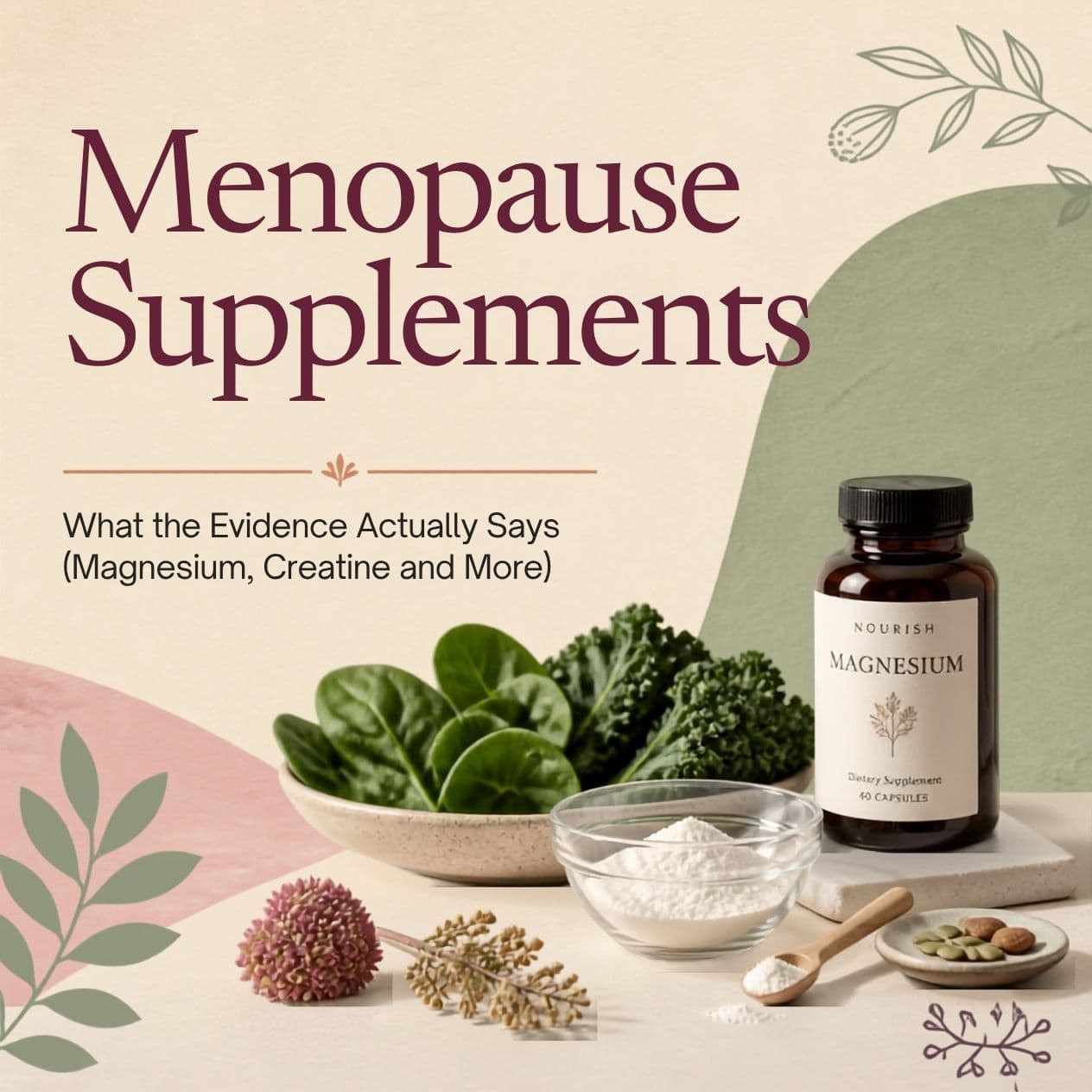
The supplement aisle has a lot of opinions about your hormones. Powders promising to "balance" them, capsules claiming to "flush out oestrogen dominance," blends with names sounding more like spells than science. If you're standing there wondering what's worth your money, fair enough, you're not alone. Perimenopause is exactly when you start reaching for anything that might take the edge off.
Here's the honest truth: some supplements have genuinely decent evidence, others are mostly marketing. Let's sort one from the other, using what the research actually says.
Big picture first: hormone therapy is the most effective treatment for many menopause symptoms, more on what that actually involves in Australia in HRT in Australia. Not everyone can or wants to take it, but supplements aren't a replacement for proper treatment. They're the supporting cast, not the lead.
How to read a supplement claim
"Hormone balancing" and "detox" are red flags, vague enough to promise everything and prove nothing. Your body doesn't need "balancing" by a capsule, it needs specific nutrients or therapies at tested doses. Better question: has this actually been trialled in menopausal women? A supplement tested on 25-year-old male athletes tells you very little about what it'll do for you at 3am in a damp t-shirt.
The standouts
Magnesium, the quiet multitasker. Involved in 300+ metabolic processes. For sleep: may help you fall asleep faster and cut insomnia severity, which matters given roughly 1 in 2 women get sleep problems in perimenopause (the full sleep strategy, CBT-I included, is in Waking at 3am). For mood: meta-analyses suggest a slight reduction in anxiety, especially if your levels are low, "slight" being the operative word. Also supports bone density. Citrate and glycinate absorb better than oxide, check the label. High doses can give you diarrhoea, start low, and talk to your doctor first if you've got kidney issues. Hasn't been shown to help flushes though, if that's your main symptom, spend elsewhere.
Creatine, not just for gym bros. In one 14-week study of perimenopausal women, it significantly improved strength and sleep. Given muscle mass drops 3 to 8 per cent per decade after 30, anything that helps you hold onto or build it has knock-on effects on metabolism, joints and independence later. Potential improvements in memory, concentration and mood too, though those findings are mixed in postmenopausal women specifically, and generally considered safe, check with your clinician if you've got kidney problems. (If brain fog's your main issue, the full post is here.)
Reviewers reckon magnesium and creatine are the two most advantageous supplements going, if you're only trialling two things, make it these.
Collagen, modest but real. A year-long study in postmenopausal women found a modest but significant bump in bone mineral density versus placebo, not nothing in a supplement world full of untested promises. Also possible reductions in joint pain and stiffness, especially with osteoarthritis, evidence still developing. Look for hydrolysed collagen, better absorbed.
Lion's mane, interesting but early. Animal studies promising, human trials limited and inconsistent, and here's the key part, zero trials in menopausal women specifically. Not useless, just unproven for this exact situation. Unlikely to cause harm for most people if you're curious and budget allows, but it shouldn't be your first, second, or third investment. Park it.
Before you start
Talk to your GP or pharmacist about existing conditions (kidney disorders change the picture for magnesium and creatine), medication interactions, and whether blood tests for actual deficiencies make sense before you supplement. If your levels are genuinely low, useful info. If they're fine, you've saved months of buying something you don't need.
Severe symptoms disrupting work, sleep, relationships? That's a treatment conversation, not a supplement conversation. About 1 in 4 women fall into that severe category, and there are effective medical options.
The Australian fine print
Supplements here aren't assessed the way prescription meds are, a product doesn't have to prove it works before it lands on a shelf, which is exactly why claims run so far ahead of the evidence. Look for an AUST L or AUST R number, showing it's listed or registered with the TGA. AUST R and AUST L(A) products have actually been assessed for efficacy, plain AUST L just means listed, not evaluated for whether it works. Be wary of overseas orders that skip Australian checks entirely. Your pharmacist can flag clashes with your meds for free, one of the most genuinely useful five-minute conversations available to you.
Track it: before starting anything new, rate your top three symptoms 0–10 in a phone note. Trial one supplement at a time for six to eight weeks, re-rate weekly. One change at a time is the only way to know what's actually working versus a placebo with good branding.
Your action plan this week
- Rate your top three symptoms 0–10 before changing anything
- Talk to your GP or pharmacist about magnesium and creatine specifically
- Check labels for absorbable forms
- Trial one supplement at a time, six to eight weeks
- Symptoms severe or disrupting daily life? Book a GP appointment, supplements are the supporting act, not the headliner
The Symptom Tracker is where you log your before-and-after ratings when you trial something, so you've got real evidence of what's working, not just a feeling.